The necessity of madness

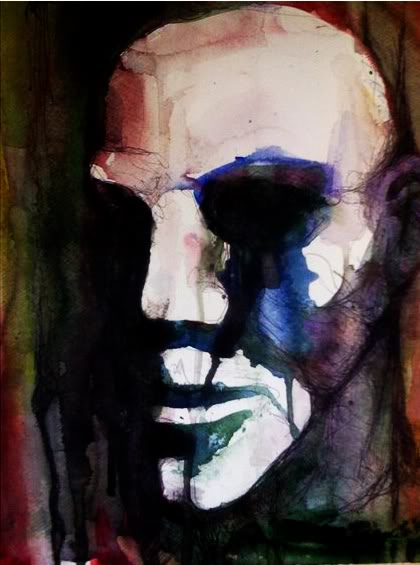
madness


That the world is coming to a dramatic end, there is no doubt. The senseless habits that occupy our days and the recurrent suffering that strikes our hearts are nothing less than signs of an exhausted species, a moribund creature. We are hanging from a crystal thread that will snap as soon as we begin trembling too much; and it is bound to happen for panic and fear are the approaching certainties in our uncertain world. The feigned order we see in this world is accomplished only by the most ailing methods. The structure of our societies, politics and ideals are childish mirages that are sickening our marrow; from the hopeless effort to create a functioning world will sprout the most disastrous consequences. As long as we quietly consent to the monotony of capitalism, the guardian role of politicians and the greed of our material dreams, the monster inside will grow more impatient, more violent, more desperate and will soon rise to devastate the utopia of a frightened race.

The problem begins by avoidance. We have avoided very skillfully the mysterious circumstance of being flesh and blood machines wandering through a colossal void in uncharted space. We have avoided awareness in order to just act out a scheme that is blind and absurd. We are doubly cursed for being an animal that thinks. Animals are innocent of our sin because they have no prolonged awareness of their circumstances, they can only act and remain in their true state. Our role would have been the same if the spark of damned consciousness would not have arisen in us, making us slaves not only to action but also to unnecessary thinking. The problem as it stands nowadays is that we cannot escape our second function, and the need to think is something we cannot avoid but must bear it as a sickly appendage. As soon as we start thinking the world becomes complicated and conflictive. It is too late for us to return to the blissful ignorance of animals and plants; we must bear the seal of our punishment and fulfill it to the end.

The tension begins when we have to conjure up all the rational bits that create a human moment and its interpretation. Memory explains the present by that which we learned and saw in the past. Both in normal life and in intellectual activities the memory functions as the glue that unites pieces of the fluctuating flux, trying to create a rational and understandable structure. Memory is a kind of discourse, a narrative we must have at hand to make rational sense of the world. The frontiers of our mind and its ability to shape and transform the external world are limitless. The 21st century has inherited a vast wealth of experience and knowledge that has enabled any one member of our species to access any kind of information within seconds. What seemed like an advantage in the natural world has now become an omnipotent weapon, able to pierce history to the beginning of time and reach the slumbering interiors of molecules and atoms. That capacity is out there as we live our day to day and ignoring our potential will only feed the anarchy that is to be born. Yet this potential is unattainable and misleading because our tools are inadequate. We cannot grasp an irrational universe through the rational thought of a human being. This assertion is not meaningless; it is as accurate as saying that you cannot contain water inside a strainer. The world is water and our intellect is a punctured container. Some things are not meant to be. The paradox is clear: we act as blind uncaring weaklings but carry the rage of a powerful intellect inside. Our power overwhelms us, we succumb to its ferocity. It tells us that things are not right but we wish not listen to that prophetic voice.

We are speaking here of the dream of a coming apocalypse. Such a view should not be taken literally. Humans will live much longer but blood and despair will taint future’s sky. Look at the hysteria of our age. We have reached the utmost tension of this struggle. The mind has rebelled against the Herculean responsibility that was appointed to it: to maintain order in a disorderly world. At this very point, when centuries of illusion are challenged and we cannot no longer continue as hypocrites of a corrupt world; exactly when we give up on our young hopes and reveal the frailty of our fragile world, then we will cross the threshold of madness. That is to say, we will enter a perceptual world in which reasons and rules break down and only the spontaneity of the moment reigns. A deliberate jump into chaos— a word that will one day signify liberation, release, realization. To have renounced the artificial laws and codes, the shackles of money and possessions, the sterility of reason; a day in which freedom will be here but will reveal how atrocious and belligerent we really are. Strife and conflict will prevail in direct proportion to our greed and neurosis. Only when we have erased the inherited layers of insanity may we return to a harmonious relationship with nature. The approaching sorrows will serve as our Purgatory – a redemption that will only be possible, alas, as we journey through madness.

Return to Beyond Language


WIDER HORIZONS – An essay on experiential limits to truth

“The intellect [as] a local effect of evolution, a flame, perhaps accidental,

which lights up the coming and going of living beings in the narrow

passage open to their action; an lo! forgetting what it has just told us,

it makes of this lantern glimmering in a tunnel a Sun which can

illuminate the world.” Henri Bergson


Revolutionary insights are bound to occur every few centuries. Evidence for this is clear since we stopped regarding earth as the center of the universe nor our solar system as the only existent planetary system; the “island universes” discovered in the early 20th century later became proof that we float inside a great vacuum filled with galaxies and our position is not in any way advantageous: we are merely an anthill in a vastly greater desert. Revelations of this sort change the root of all our understanding of the human being and his position in this strange universe. The above discoveries lead to a re-conceptualization of our place in the material plane. There are other revelations that force us to reevaluate our previous conceptions at a cognitive or intellectual level. Kant believed to have transformed philosophy with the same impact that Copernicus’ theory revolutionized astronomy. However, his philosophy as influential as it is, couldn’t produce the radical transformation its author had anticipated. In more recent times Heisenberg dramatically redefined the future of physics with his Uncertainty Principle, setting a perennial barrier to the accuracy of information we can obtain at the subatomic level. It will be safe to speculate that world-changing insights will continue to appear throughout history.

Because we are so immersed in our own opinions and hold with unswerving faith our convictions, it is no surprise that it becomes difficult for us to accept, much less digest, what new ideas are pointing at. The evolution of human knowledge is constantly pushing for wider horizons, breaking free from assumptions that were once crowned as truths but are in reality only provisional scaffolds that permit the growth of more profound insights. Such may be that case with our idolatry to matter; ever since science usurped almost every field of knowledge proclaiming that epistemological certainty is only possible through objective (that is, physically oriented) evidence.  Steadily ever since Einstein tried to unify electromagnetism and gravity there has been an increasing wave of believers in a unified theory of reality; which in closer analysis is a pretension to explain the entire universe, or all that is, by physical mechanisms. It rests on an unproven assumption that can be summarized like this: because we are able to perceive the physical universe with our five senses and technical apparatuses, everything we perceive can be explained from that which we perceive. In simpler terms we are convinced that there exists nothing more than what we are able to perceive or deduct from our perception, and although this sounds like the plainest commonsense, we should carefully rephrase that assertion to: we can only discuss what we perceive. But we should not discard beforehand the possibility that this world, every phenomenon at the experiential level, may be simply a fragment of a vaster and greater reality. This does not imply that that greater universe which we cannot perceive should be a concern to science and philosophy but it simply comes as a warning to our proud advancement of knowledge. My case can be summed up in the following way:


If our awareness and intelligence arose out of earlier biological experiments, its persistence on this planet must only be explained by the advantages it has given to our species. Its function has been to assist the survival of our kind and not as we now presume, to solve the riddles of existence. Intelligence did not arise to survey all the scope of whatever exists but only to aid the organism in its survival with its immediate environment. This may be a total and insurmountable obstacle for the arrogance of science and philosophy; merely because there may be dimensions of reality we are not designed to perceive, causes that may influence the physical universe which are not strictly perceivable nor deducible from physical phenomena. This condition could set an experiential limitation to our knowledge –not unlike the uncertainty principle – forever and ever concealing absolute truth from our grasp and revealing us not as possessors of facts but merely as gatherers of illusions.


knowledge_in_21st_century

Return to Beyond Language

The world’s a machine


^ A by ytuquike
http://ytuquike.deviantart.com/art/A-32785575


Let me tell you something. It may be a hard pill to swallow. No, on second thought, maybe my criticism is hollow and attempts to belittle a world too powerful to be challenged. Besides, most people are already aware of what I’m about to say. We all are. But it doesn’t matter. I must get it out; otherwise I’ll wallow in my own disgust and perpetuate a system too cruel in its indifference. 

I‘ve been sitting here for seven hours. Patiently chatting with customers over the internet, satisfying their demands, answering their recurrent questions. Yeah, it’s as simple as it sounds.  A few minutes here with a Dan from South Africa, a few seconds there with a Marysia from Bulgaria. I’m connected to the world but between me and the rest of the globe there’s a box that displays organized patches of light and allows me to interact with people I will probably never encounter, physically or virtually, again. It’s just that – organization – that bothers me. Here I am at the threshold of a global society and my enthusiasm is imprisoned under a thick layer of discomfort.


It doesn’t make sense to me. How we got here and all that. I was involuntarily born into a world that had organized itself in this way without my consent. Here I am functioning according to it, adding fuel to its monstrous engine by my insignificant but necessary participation in its affairs. I am a mere appendage to this colossal machine, a machine that keeps rolling on and on without any constraints – makes me wonder if we could stop it should we desire to?


That fact is that it is here, an organization a priori to my existence, and I must operate according to its rules; my life with its sufferings and joys must fit the frame of modernity; my dreams are shortened by 40 hours a week which are mandatory for my basic survival. I’m no utopian, I don’t trust in any universal remedy for happiness and prosperity, yet even with my mistrust in progress I’ve perceived the approach of a conviction that promises a better world, a saner reality.


Hadn’t fear regulated most of our expectations, or if habit wouldn’t paralyze our imagination, would we still be living for minimal wages and restricting life to those scarce hours of leisure that work “allows” us? While trapped in those routines of cement and asphalt, how often do we get to experience the beauty of nature which, according to poets and sages, delivers endless moments of delight and communion with the divine?


I don’t know, I don’t care. I will continue to intoxicate myself with the monotony of uneventful hours… who cares what a screw thinks when the machine can operate without it. New screws will be born to furnish The Machine with the elixir of eternal life, namely:
  

Our conformity.


Return to Beyond Language

Awe and confusion swirled together

pain

Pain by Hands of Crimson (deviantart)

We fling ourselves out into the depths of this tumultuous motion (there is always an implicit decision to stay alive) – we are agonizing in the effusion of forms, attitudes and energies of this world, we succumb to the simultaneity of all events, approaching a boiling point which will end in a devastating orgasm. This life that with relentless power can lift you to regions of unshakable astonishment will drop you with equal force into the pits of boredom and suicidal retreat. It becomes an experience so intense that all those wonderful insights attained by your constant awareness to the profundity of existing forms can be, and will be, torn apart by the abysmal fissure that comes in between reality and our conceptions. Our epoch has demystified the themes of history, art, philosophy, science – any study that pierces Being and divests it from the shallowness of routine – themes we are engaged in by our simple breathing and acting  in a world that is constantly being measured, recorded, discussed and because of these, it is being doubted more than ever.


Out of the circumstance of standing on the axis of what is to come and while repeating beyond illusion the experience, over and over again, of existing as part and parcel of this monstrous universe – out of all these circumstances there arises a sentiment which remains for the most part unspoken yet when united to the urgency of our desires it wishes to break through as a divine voice, a repercussion that will echo through the immensity of space and time, an outpouring of this vital disbelief that defines our existence; in short, an eternal statement understood and recognized by everyone:


Can all this be real?


Exactly because the world’s diversity can only be matched by its incomprehensibility the human being, passenger in life, is unable to remain in the state of absolute veneration (the all-too-common fear of the unknown) and must distract himself with whatever nuisance is thrown in his way. Fortunately, there is excitement in monotony; there is pleasure in painful depressions.


We are obeying something vastly superior, something that always exceeds our two modern poisons: reason and technology. We aspired to imitate nature with those silly contrivances. We, subjects to our bodies, to history and the course of the planet, we return to bed every night insulted simply because we cannot deceive ourselves much longer: the world we have come out of has created itself and us without the tool of reason; and in that inexplicable unreasonableness it has fashioned machines infinitely superior to our latest technologies – we see it all around us, the biological world, a miraculous product abandoned by the silent God of Purposelessness.


After we finish with this continuous enigma, we open our eyes to challenge again the naked world, to tease it with our actions and desires….
“oh what a world” we say,


and reenter the game once again.


Go back to Beyond Language

Trapped in nothingness

It seems to be I am locked inside this excessive silence. That while I look up into the hazy azure of the sky or into the windy skies of night I discover an impenetrable void, a silence that cannot be breached, a solitude that is here to stay. My arms plead with desperation for a sign, my ears are on a pilgrimage in search of a sacred word – a confirmation that life can be trusted. A revelation or miracle that can transform these wild gyrations of nonsense into a lively and trustworthy universe.  Long tunnels of agony and atrophy seem to be the destiny of those that aspire to awaken and revive human life from its muddled lethargy. But being trapped inside an inescapable chasm, I have only the ignoble expanse of space to address and all of creation turns its back on me and answers back in SILENCE. I am not insightful enough to interpret my own frustrations, I cannot tell if it is a general trend in this new age or if I stand alone in this inexplicable confusion. Furthermore, the only remedy comes in strings of lyrical eruptions that at first sight seem vague and meaningless, but are in fact projections of the real ambiguity and hollowness that resides deep within. It is unnecessary to find coherence when one is no longer servant to the tyrant of reason, it is superfluous to propound theories when the intellect is too weak to grasp reality. So, the image is inevitable: floating in cold nothingness, silent solitude. A journey through emptiness, a constant motion through space finding every now and then a naked planet, an aura of beauty and patiently collecting the dust of time in expectation of a glorious sun – surrendering to the all-powerful ground of being.

An Attack on Science


Science is based on an unscientific judgment of value. Science and its followers claim that knowledge and truth about the world are only possible through the scrutiny of the scientific method. Therefore, all other sources of knowledge are doubtful, if not, downright mistaken. It eradicated subjectivity from its grand representation of the universe and claims to speak as matter-of-fact and objective as possible.  However, the scientific enterprise has still to prove why we should deal with the cosmos as a problem to be solved; it has yet to answer why knowing is much more important than any other human activity. The great technological benefits we enjoy today are not at all essential; we clearly see the animal world enduring without vehicles or television, or notions such as gravity and entropy, such ‘animals’ even have very complex societies or innate flying abilities. Therefore science cannot claim to be the ultimate route to a better and wiser life, it is a historical phenomenon existing only for the past few centuries and not necessary to life on this planet. In this sense science is morally unscientific; it cannot provide evidence for why a scientific attitude is more preferable than, for example, an aesthetic or nihilistic one. This is simply because science has not been able to predict human emotions or chart our future decisions, it has nothing to say about what we should do; it merely states what is not what should be. 

Scientific-minded people believe themselves to be the most rational minds today. They have associated rationality with one method of inquiry (i.e. scientific method) and have abolished all other sources of data and knowledge. This seems to me more like a limitation than an advantage, precisely because science cannot deal with the whole spectrum of our experience. It works simply on the observable external phenomena and has yet to contribute to an understanding of human consciousness. It pretended for many centuries to get rid of this uncomfortable fact but the shadow of consciousness has crept into modern physics and it is now clear that even basic physical concepts such as mass, distance, velocity, time, are dependent on an observer. In a broader sense, rationality should encompass more than just science and its mother logic, considering that science is narrowly limited by its inability to connect with our whole experience of life. In other words, we are aware of things that the analytic mind cannot formulate. The rational discourse of science is incomplete; it cannot be the entire picture since it lacks insight into our inner life which is as real and undeniable as the external world. For this reason we can learn about life equally as much from a scientific treatise as from a novel, a poem, a kiss or a beautiful landscape. 

(This is not an attempt to invalidate science but simply a reminder that the powerful mystery of life cannot be grasped from one perspective. Those that are dedicated to the exploration of existence must remember: there are no official paradigms; we alone bestow authority to whatever we choose to believe. We cannot limit the cosmos to certain aspects of itself, it is beyond our attempts to reduce it to one knowable thing.)

Fatalism

If we must submit to the irrationality of following all logic to its end, conclusions may turn shockingly paradoxical. I once heard that we have chosen our life from the very start and that our experience on this planet is simply the revelation of our original choice. If this were true then the absurdity of our suffering would be justified since we have chosen beforehand to experience it. The question that remains would be: why have we forgotten our original choice? Why does life present itself as an unknown unfolding instead of being the realization of one’s desire? By some obscure mechanism our original choice has been obliterated, life remains a permanent surprise. At first this seems like another form of fatalism except for the fact that we have chosen that predetermination. On the other hand, most people believe that the universe is a spontaneous happening and we must choose our way through the hazards of spontaneity. Our life is the result of all our choices, but how do we ever get to choose anything? I sat down the other day to think this one over and I discovered that my choices are really just reactions to whatever is presented to my mind. From the pettiest choices to the most important decisions I simply obey a feeling, logic or a whim. In all of these cases I am subject to what simply happens inside me. Should I buy a black or blue pen? I wait for a moment, experience a certain sensation of pleasure in black and I buy the black pen. Should I live in Costa Rica or in India, I wait for a moment, a logical-emotional labyrinth emerges in my mind and by the end of this involuntary frenzy, I make my decision. Naively speaking, thoughts are like emotions, they arise involuntarily and by a law of their own. Most people are identified with their thoughts, but if you ask them how they fabricate a thought they must inevitably answer: it simply happens. So, if my decisions are nothing but reactions to what is presented to my mind, what is allowing these perceptions? If we submit to modern scientific thinking, to explain a perception in the human mind we must pursue a long path through Psychology, Sociology, Biology, Evolution, Neurology, Chemistry, Physics, and we will end up with an ultimate theory for the universe as seen by man. In very simple terms, what we experience is the result of the whole arrangement of the cosmos, and if we knew every bit of information about this arrangement, we could predict ourselves. Again, we fall into an unremitting fatalism.


But what’s the use of all this reasoning and the contemporary compulsive adoration to logic and reason?


 I choose not to know.


“Puppet on a string” by Steve Whitney

The Problem of Free Will


 Are we as free as we think we are?

The problem of Free Will is inextricably linked with a scientific belief. This belief is in itself perhaps older than formal science but nonetheless it acquired great force with the birth and development of the scientific enterprise. It can be stated thus:

 Everything in the present is the direct result of the configuration of the past.

Nothing is without a cause. Thus, whatever we encounter in a present state can be explained or understood by its former state and the natural laws involved. If this belief is to be adopted thoroughly, if nothing can escape causality, then anything we experience has a direct cause in the past.

When we bring this kind of reasoning to the debate of Free Will, we can conclude in the following manner:

Psychic phenomena all have a cause regulated and governed by natural biological laws that at present we cannot name them all. Whatever we experience in the present is inextricably linked to a past state of affairs.

We understand Free Will as the ability to make an act or decision independently of any necessity compelling us to choose one thing over another. Stated this way it seems that the act of choosing has escaped the law of causality. But if this is to be rejected by our common scientific understanding of the world, we arrive at a different conclusion. Any decision-making process is only possible when the individual is in a particular situation where (s)he reacts to the evidence or stimuli presented for making a decision or act. This stimulus is the psychic content, patent or latent, that takes part of the decision-making moment. To pick an apple over a banana is the result of the apparition in the individual’s consciousness of past experience with these fruits, past reactions to these that make one fruit preferable over the other. A decision cannot be achieved without the pre-existent conditions for making a decision; that is to say: desire in the individual for eating (something that is quite involuntary), the past experience with the objects and objectives of the decision or act. Bound to memory, expectation, desire, and many other, the decision-making process is dependent on psychic phenomena that arises in the mind without a conscious or voluntary action. When an act of “Free Will” has taken place we remember the act, and the possibility of choosing otherwise, but we forget the requirements for us to arrive at the chosen action. The action was conditioned by involuntary psychic phenomena, something which we do not control and therefore acted out of a necessity towards this stimuli that was presented to us: Desire, Aversion, Memory, Imagination, Etc.

In such a way the problem of Free Will can be reconciled with the idea of causality. And with this knowledge now in mind the upcoming decisions will be influenced by this new awareness. We may doubt at the moment of decision-making in order to prove our putative freedom, but we are still only reactions to involuntary psychic phenomena that permit the processes we call free and voluntary.

However, to understand the laws of the human psyche at the present seems unlikely because of the complexity involved; the apparent arbitrariness or spontaneity of the stimuli that allow our decisions to take place is sufficient to permit our current morality – based on the supposition that we are free agents making responsible decisions – to remain established.

::::::::::::: APPENDIX ::::::::::::::::

The main idea behind this short inquiry is to reconcile two basic assumptions we have about the world.

1. Everything is the effect of a cause. Therefore all effects can potentially be explained or understood by their causes. (A general accepted supposition in our contemporary scientific culture)

2. We are free agents, making decisions independently of any external necessity obligating us to make a certain choice.

These two assumptions we all have in the back of our minds are in stark contradiction. How can we be free if everything in the world is determined by natural laws and follow an unchangeable course? We then would be part of the immutable course of things and all our actions are predetermined since the beginning of time.

If we follow the suggestions of logic, we will conclude that we are nothing but puppets manipulated by the general course of nature’s laws. However, we don’t feel this to be the case. We feel we ARE free and independent.

The above paragraphs attempt to show that we may be deceived by our belief in Free Will. Simply stated, our decisions are not made by an omnipotent-omniscient ego that at each moment can decide what it wills. Our decisions are based and chained to mental phenomena that arise involuntarily into our consciousness (that is to say it appears quite without our consent, as a cloud would appear suddenly in an open sky). This involuntary phenomena (desire, aversion, fear, tribulation, excitement, anxiety, and countless others) determine the choices we make. Our choices have natural causes that do not depend on us. With this explanation we can find causes for our decision-making lives and discover that we are not as commonly believed: free creators of our destinies.

However, if we can find reason to doubt the first assumption: everything has a cause by which we can know the effect, then Free Will may be conceived without logical contradiction. And it is wise to reassess our dogmatic belief in science and the principles of causality, which may be in the end altogether mistaken.

Isolation


Isolation.

Breathtaking isolating metaphysical estrangement. I am the voice of a prison, an oasis of consciousness locked up in a bottle that is floating on an ocean of beautiful nothingness. There is nothing but myself. But “myself” isn’t human. Consciousness is the moment of absolute silence before sneezing. We are the void that is never heard, we are the undercurrent of a stream that can never rise to the surface; we are motion without name. The unreality of it is not a punishment – it is a promise that nothing – nothing can condemn us to eternal misery. Every pain is a thorn, every joy is a petal: but there is no rose to eternalize them. Life is a dream that will never surrender the mist of its illusion.

We are a particle in that dancing mist,

                         flashing in the light of time,

                                   vanishing in the darkness of boundless sleep.

Liberation

Free wanderers of the spirit, you astronauts in the lost space of indecision, all of us that have noticed and condemned the irrationality of our age, yes, you passionate survivor that in the mist of these nonsensical years battle through the current of conformity in search of a justification, a raison d’être, a simple satisfaction that will overshadow the ever-lasting presence of frustration.
We are the inheritors of a struggle that has pervaded all of history. Our efforts so essential in the field of human potential must never come to an end. In these complex societies that require even more complex solutions to cure the collective madness, our perseverance must not wane. Even if most attempts to heal the wound of civilization have failed throughout history, the spirit of the rebel will live on as a child of that irrepressible force that commands human existence: an energy that will ask of us to emancipate man from his self-imposed shackles.
Our mistrust in human conventions, ideologies, and reforms should not stop our search for an immediate liberation, a source of enlightenment, a spring of contentment. In peeling off all boundaries we still have a chance of finding a secret treasure in nature, beauty, art, brotherhood, work, love, poetry, even in the darkness of suffering or the maniacal passion of a philosopher, somewhere within these and all inspiring things we may stumble across a beautiful sensation of peace, a harmonious agreement with what is most essential in life.
But what is the most essential?
This each wondering mind must seek but I am sure that with sufficient honesty and perseverance we can find that basic need and satisfy it sanely. Then we may watch our torments wither away and vanish as our reality elevates itself into a more exciting and promising realm.
Allow this vision to settle in:
Long, unanimous cries and shouts into the open sky, not from another fascist’s Holocaust but from an inexplicable mad ecstasy, the long-awaited contact with pure joy.