lessons in finesse

Taking a dump

A standstill collapse
     locked door

sneaking a peek
to glimpse the rotting fuel
tunneling down a pipe
these anchoritic pieces
of me
falling into the orgy
of
   classless waste
— a humming noise
coming from the wall

and
           the thought
that you’ll never leave
this toilet alive

why should i?

this could be my last
excretion

my masterpiece of unpremeditated
feces

the revelation of the kingdom
of heaven
precisely when my
fat butt cheeks
begin to contract
 for the final
plunge
(into the consciousness
of process and
       decay)

jesus lord the fetidness
now
the work of
cleaning the gorge

my hands
 gosh my hands
have mastered the crevice

SPOTLESSSSSS!

i stand, faucet, dry

Unlock
the world

return to the busy society
as another impeccable
glamour divinity
of the
human
race.


Modern Poetry

pieces and failures

Call me the hunted man
I’m the stranger in your claws
the convict in your laws
I drink the poison of your bars
but I’m not the drunk as this life
inebriated with pursuits
I toast to immensity and curiosity
my life phenomenon strangest consciousness
painted beauty on the orbits of seconds
ideas that have misspelled their democracy
dreams that disinherited their syntax
love for your lost eyes
too shy to reach the earth
I’m the Nostradamus of the irrational
unable to predict the literature of the collective desire
in the mouth of September twenty ten
we will drown in the saliva of tedium
then, BANG!
in the glory of being
a tsunami of heartthrobs will flood us
our voices in unison
     my lord the white blue green yellow of joy
     has painted the flag of my new devotion
     let all creation be the mathematics of ecstasy
I’m the comedian of impossible utopias
jokes for the philosophers of tears.


modern poetry

the thought of us together

Life of the Modern Poet

Name me
the pits of existence
the minor spots
where it is safe to stop
stop and write a poem
I can’t wait till I die
so I can write about it
in the last scribble of consciousness
I will be there narrating:
               light, angels, war, sex, infinity lied
I am waiting to hear
your confession
all progress – vain
stop…
join me
in the cracks, corners, alleyways
the gutters, the nooks, the black holes
take the next exit
let’s rest near a perception
write a verse or none
we’ll sit and gaze
stargaze the stampede
the whole tumultuous downfall of the manned-world
                                  as distant as galaxies
just you and me… preserved
                as a poem.

contemporary poetry

The nihilist

A true nihilist would remain in silence, write not one verse or statement, would speak concisely the bare minimum needed for survival, short ambiguous phrases. Such a person would greet and live amongst people only in so far as he sees them as intimately unreal as his bubbling dream-thoughts, as his dream-desires, as his dreamed dreams. The true nihilist would be amazed by everything, from an ant that crawls over the index finger to the cold hairs of despair; every thing becomes an unknown appendix to a greater unfamiliar reality. He would have his coffee and smile because he is a passenger of time, or perhaps, he may consider being suddenly born into the suit of a wholly grown man that conducts his thinking through the agency of amputated words. The nihilist, if one ever existed, would come and go with the tides of the ordinary, would probably visit too landscapes in consciousness that a believer of truth could never reach (truth being an ten-ton burden); that nihilist, if so much can be said, would render all things possible and would make of contradictions and paradoxes household items with which he interacts daily.

The nihilist takes his coffee without sugar and life without objections.

Nihilistic Poetry

An Attack on Science


Science is based on an unscientific judgment of value. Science and its followers claim that knowledge and truth about the world are only possible through the scrutiny of the scientific method. Therefore, all other sources of knowledge are doubtful, if not, downright mistaken. It eradicated subjectivity from its grand representation of the universe and claims to speak as matter-of-fact and objective as possible.  However, the scientific enterprise has still to prove why we should deal with the cosmos as a problem to be solved; it has yet to answer why knowing is much more important than any other human activity. The great technological benefits we enjoy today are not at all essential; we clearly see the animal world enduring without vehicles or television, or notions such as gravity and entropy, such ‘animals’ even have very complex societies or innate flying abilities. Therefore science cannot claim to be the ultimate route to a better and wiser life, it is a historical phenomenon existing only for the past few centuries and not necessary to life on this planet. In this sense science is morally unscientific; it cannot provide evidence for why a scientific attitude is more preferable than, for example, an aesthetic or nihilistic one. This is simply because science has not been able to predict human emotions or chart our future decisions, it has nothing to say about what we should do; it merely states what is not what should be. 

Scientific-minded people believe themselves to be the most rational minds today. They have associated rationality with one method of inquiry (i.e. scientific method) and have abolished all other sources of data and knowledge. This seems to me more like a limitation than an advantage, precisely because science cannot deal with the whole spectrum of our experience. It works simply on the observable external phenomena and has yet to contribute to an understanding of human consciousness. It pretended for many centuries to get rid of this uncomfortable fact but the shadow of consciousness has crept into modern physics and it is now clear that even basic physical concepts such as mass, distance, velocity, time, are dependent on an observer. In a broader sense, rationality should encompass more than just science and its mother logic, considering that science is narrowly limited by its inability to connect with our whole experience of life. In other words, we are aware of things that the analytic mind cannot formulate. The rational discourse of science is incomplete; it cannot be the entire picture since it lacks insight into our inner life which is as real and undeniable as the external world. For this reason we can learn about life equally as much from a scientific treatise as from a novel, a poem, a kiss or a beautiful landscape. 

(This is not an attempt to invalidate science but simply a reminder that the powerful mystery of life cannot be grasped from one perspective. Those that are dedicated to the exploration of existence must remember: there are no official paradigms; we alone bestow authority to whatever we choose to believe. We cannot limit the cosmos to certain aspects of itself, it is beyond our attempts to reduce it to one knowable thing.)

A Modern Hero

A modern hero
Hero-1

We can watch him quietly chewing his dinner. His gaze is imperturbable and his thoughts invariably these:

The nothingness that exists in all forms, and the nothingness that is yet to be born.

The modern hero awaits (and this waiting period is interminable) for a fatal threat. This threat is anticipated throughout the cycles of the clock. It is always approaching, never disappearing.

What can he do?

Nothing. Resisting the menace of existence is a futile and wearisome illusion. He will initially find himself in hypertension, guarded against an invisible enemy. Since there is no defence against his opponent, rebellion would represent a defeating madness. Acceptance must be learned and practiced. However, salvation is not achieved solely by the acceptance of one’s own precarious situation. He has no escape, he must sacrifice a distracted and unexamined life in order to become bearer of a strange suffering.  He will be the hated antagonist of any unfounded human optimism.

For what?

To cure himself of a malady that is not only his own but also a dormant illness that all conscious beings carry within.

What relieves him?

From the perspective of the world he has secluded himself in an abstract and spurious discourse; from the perspective of his own condition he has renounced his faith in a world of form and substance, he has lost trust in the socially approved states of consciousness. He lives in a mythological world, albeit, his myth has not yet been written nor can it be.  He is dispersed in a flux of perception that not necessarily implies an objective external world. His experience cannot be communicated, it does not have the logical structure of a normal human situation.

Is there a light at the end of his tunnel?

From the standpoint of the all-too-human, suicide may appear as the last desperate, but effective, act of liberation, but this won’t be his course. He has selected an ambitious journey: The transmutation of consciousness. An intuition convinces him that the reality we live in is only one of many possible creations; and in the sober creation of less restricted states of consciousness he will achieve his ultimate objective: inner peace.

The Problem of Free Will


 Are we as free as we think we are?

The problem of Free Will is inextricably linked with a scientific belief. This belief is in itself perhaps older than formal science but nonetheless it acquired great force with the birth and development of the scientific enterprise. It can be stated thus:

 Everything in the present is the direct result of the configuration of the past.

Nothing is without a cause. Thus, whatever we encounter in a present state can be explained or understood by its former state and the natural laws involved. If this belief is to be adopted thoroughly, if nothing can escape causality, then anything we experience has a direct cause in the past.

When we bring this kind of reasoning to the debate of Free Will, we can conclude in the following manner:

Psychic phenomena all have a cause regulated and governed by natural biological laws that at present we cannot name them all. Whatever we experience in the present is inextricably linked to a past state of affairs.

We understand Free Will as the ability to make an act or decision independently of any necessity compelling us to choose one thing over another. Stated this way it seems that the act of choosing has escaped the law of causality. But if this is to be rejected by our common scientific understanding of the world, we arrive at a different conclusion. Any decision-making process is only possible when the individual is in a particular situation where (s)he reacts to the evidence or stimuli presented for making a decision or act. This stimulus is the psychic content, patent or latent, that takes part of the decision-making moment. To pick an apple over a banana is the result of the apparition in the individual’s consciousness of past experience with these fruits, past reactions to these that make one fruit preferable over the other. A decision cannot be achieved without the pre-existent conditions for making a decision; that is to say: desire in the individual for eating (something that is quite involuntary), the past experience with the objects and objectives of the decision or act. Bound to memory, expectation, desire, and many other, the decision-making process is dependent on psychic phenomena that arises in the mind without a conscious or voluntary action. When an act of “Free Will” has taken place we remember the act, and the possibility of choosing otherwise, but we forget the requirements for us to arrive at the chosen action. The action was conditioned by involuntary psychic phenomena, something which we do not control and therefore acted out of a necessity towards this stimuli that was presented to us: Desire, Aversion, Memory, Imagination, Etc.

In such a way the problem of Free Will can be reconciled with the idea of causality. And with this knowledge now in mind the upcoming decisions will be influenced by this new awareness. We may doubt at the moment of decision-making in order to prove our putative freedom, but we are still only reactions to involuntary psychic phenomena that permit the processes we call free and voluntary.

However, to understand the laws of the human psyche at the present seems unlikely because of the complexity involved; the apparent arbitrariness or spontaneity of the stimuli that allow our decisions to take place is sufficient to permit our current morality – based on the supposition that we are free agents making responsible decisions – to remain established.

::::::::::::: APPENDIX ::::::::::::::::

The main idea behind this short inquiry is to reconcile two basic assumptions we have about the world.

1. Everything is the effect of a cause. Therefore all effects can potentially be explained or understood by their causes. (A general accepted supposition in our contemporary scientific culture)

2. We are free agents, making decisions independently of any external necessity obligating us to make a certain choice.

These two assumptions we all have in the back of our minds are in stark contradiction. How can we be free if everything in the world is determined by natural laws and follow an unchangeable course? We then would be part of the immutable course of things and all our actions are predetermined since the beginning of time.

If we follow the suggestions of logic, we will conclude that we are nothing but puppets manipulated by the general course of nature’s laws. However, we don’t feel this to be the case. We feel we ARE free and independent.

The above paragraphs attempt to show that we may be deceived by our belief in Free Will. Simply stated, our decisions are not made by an omnipotent-omniscient ego that at each moment can decide what it wills. Our decisions are based and chained to mental phenomena that arise involuntarily into our consciousness (that is to say it appears quite without our consent, as a cloud would appear suddenly in an open sky). This involuntary phenomena (desire, aversion, fear, tribulation, excitement, anxiety, and countless others) determine the choices we make. Our choices have natural causes that do not depend on us. With this explanation we can find causes for our decision-making lives and discover that we are not as commonly believed: free creators of our destinies.

However, if we can find reason to doubt the first assumption: everything has a cause by which we can know the effect, then Free Will may be conceived without logical contradiction. And it is wise to reassess our dogmatic belief in science and the principles of causality, which may be in the end altogether mistaken.

Isolation


Isolation.

Breathtaking isolating metaphysical estrangement. I am the voice of a prison, an oasis of consciousness locked up in a bottle that is floating on an ocean of beautiful nothingness. There is nothing but myself. But “myself” isn’t human. Consciousness is the moment of absolute silence before sneezing. We are the void that is never heard, we are the undercurrent of a stream that can never rise to the surface; we are motion without name. The unreality of it is not a punishment – it is a promise that nothing – nothing can condemn us to eternal misery. Every pain is a thorn, every joy is a petal: but there is no rose to eternalize them. Life is a dream that will never surrender the mist of its illusion.

We are a particle in that dancing mist,

                         flashing in the light of time,

                                   vanishing in the darkness of boundless sleep.

Nocturnal Studies

thebeast

Existence was always for me a dark place. It was not necessarily depressing or ominous; it was dark because it lacked explanation and purpose. But somehow, after years of purposelessness, I have begun to love life’s obscurity.

There’s something enchanting about the enigmatic — anything that conceals something deeper or unknown is generally very intriguing, like a mask or a symbol. Analysis is the ability to dive below the surface of a thing in order to grasp its inner structure. The purpose of writing is vague and uncertain. Entertainment? Transmission of knowledge? Spontaneous activity? All three are plausible but foremost, for me, writing has a symbolic function. It is the disguised voice of the raving lunatic we all carry inside. Most struggles in life are born from the dissension between our waking consciousness and the nocturnal beast that dwells in the swampy pit of our unconscious. If that treacherous monster had a voice, what would it say? It would probably roar…

If only we had the strength and perseverance to record every fleeting detail. All those frustrated desires, every old man that crossed our path, every wind that lifted a billow of dust before our eyes. What would we discover then? Do we grasp ourselves better in representations; is the mirror’s image our final wisdom?
Will the beast be tamed when he sees his own deformity?

The day the universe was reborn

    
Why keep writing in linear and logical fashion?
Writing is the outgrowth of thinking.
It should reflect the features of the human mind, with its desultory and fluctuating discourse.

When the scope of the possible has been exhausted you may turn left where a gigantic mountain separates the desert from the snow. Haven’t you felt all along that lurking behind every monotonous experience an explosive energy awaits to come forth? It is as if a powerful surge of lightning remains dormant in a recondite quarter of our consciousness; behind every yawn of boredom a rapacious thunder of delight seeks an entrance into our deaf lives.
    
Follow the rain into the heart of the storm. Then you will be ready for the revival of the new, the rediscovery of surprise.  As long as there is room for the unknown, as long as red-headed ants surprise you with wonder and interrupt the tyrannical flow of thoughts — there is hope.
    
I had begun walking in search of meaning and not far down the road I stumbled across an insurmountable obstacle: mortality. All labors are in vain if they seek permanence. This did not stop me, if I should live in a world where impermanence governs every particle of matter then my actions had to resign any sort of structure, my words had to abandon order. I had to accept the chaos of uncertainty and resume the search. No longer looking for a perennial philosophy but merely for temporary wisdom. For the most profound questions I never looked in books; I was lucky to experience them in other more fundamental objects: in direct contact with the phantasmagorical landscapes of nature or the silent dark of outer space.
Sinking in rocky jaws
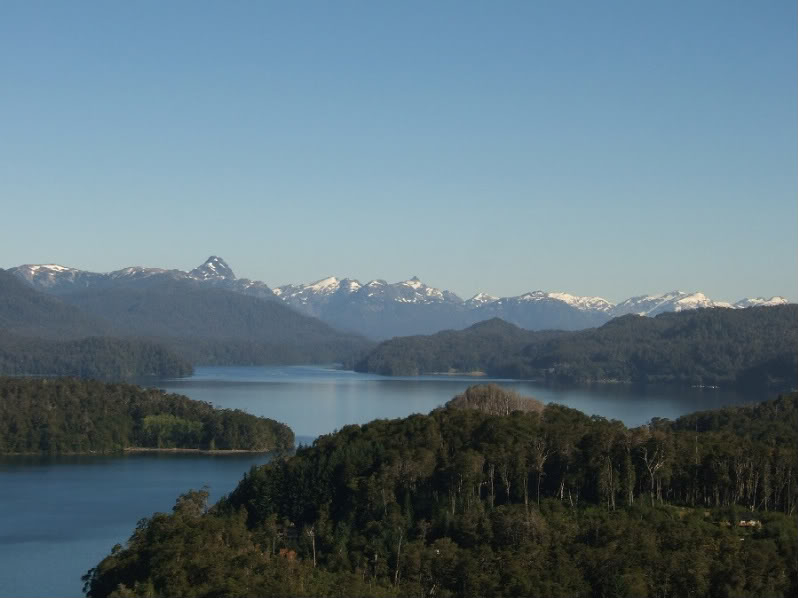
Patagonian mountains
Lakes as seas
near heaven’s azure
the universe reborn
million lights at night
transform every thing
     Living in constant disbelief I could but interpret life as total dream, the whole of existence appeared equally inconstant as the contents of any bizarre dream. Yet I am sure that defining the cosmos by the anthropocentric analogy of dream doesn’t come close to what is really happening — reality is much wilder and exuberant than our speculations. Here and there I found evidence to believe that the hardest task is change: inner transformation. We are never the Archimedean unmovable point around which all things change and evolve — we are similarly watery being flowing from one state to another. Allowing things to change within you, permitting things to grow and decay inside was surely difficult. Getting used to this internal impermanence requires great courage. The reward is priceless: the art of transformation had become the real art of living.
     At night things settle down. The pure transparency of water is swallowed by the black of night and slowly above a blurry streak of light convinces us of the utter strangeness of our condition. The Milky Way, our home galaxy, becomes the symbol of our astonishment.  In those prolonged moments of silence things are perceived differently, we are free to just be as rocks are silently existing at the bottom of a blue lake.
Is it so necessary to formulate our wonder and our wishes?
Immobile (time)
Serene (space)
a rock for ages
deep below
in abysmal Zen
Sometimes I refuse to endure the recurrent agony of dreaming my death. In times like those:
Deserts become too desolate
Mountains intimidating monsters
Cities caging of beasts
Oceans too restless
Home insipid
My grave a terrifying
       inferno
I can only live and die
within my despair
My daemon: despair. My savior: wonder. My meditation: inking a few random words. My sleep: sweet forgetfulness as the rock that rests unperturbed.
I have to ask, is The Search a consequence of despair, or despair a consequence of The Search?

patagonia_lakes