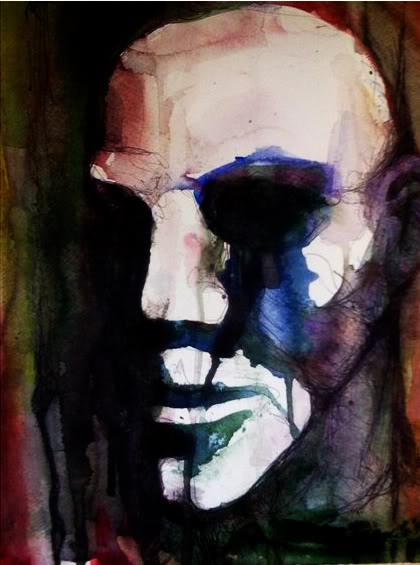
between words and things

Am I the apparition

between this thought

and you, the thing-

in-itself coming through

the flooded veins of my perceiving

with this thing there

constituting my content

while I compose its name

we are united in the poetic theme

of the present moment –

and that thing

is no other than my fragmented self

losing the virginity of conception

the birth of the concept

allowing life, my life

merge with the myriad voices of yours

closely knitted with the linen of a dreamt world

as closely as two poets speak

from unreachable regions of being

hills of this journey

how to be human

when

becoming is still in our bloodstream.


Nihilistic Poetry

A modern crisis

a_modern_crisis

We were born after a whole deal of postures and attitudes had been tried and dismissed. It seemed to me that this was the first time in human history when life was unbearable even while we have all the basic conditions for survival and a surplus of commodities. We live in the absence of a raison d’être and our very lives could actually be defined as the search for that sacred reason. We would and probably will travel around the globe and consume every possible experience in search of that elusive understanding that could justify and make sense of all the seemingly senseless gyrations between birth and death, hunting for that catharsis that would erase our feelings of inadequacy and insufficiency.   
If I am allowed to make a stand on the current emptiness that governs the modern rebel (and I must state that this rebel is even reluctant to assume this label), I could place him or her within a crisis of value. Let’s formulate this crisis. The ‘fortunate’ human being that is born in a middle-class or higher family is bestowed an excess of leisure, which is occupied with an endless parade of distractions, vague and short-lived entertainments that do not provide deep-rooted satisfaction. This repetition of material hedonism is deceiving and can engage the individual in a merry-go-round of renewable pleasures that are futile in their long-term effects. What an overwhelmingly urban and global society presents as the content and purpose of leisure is more often than not a distraction, a veiling of our impoverished consciousness. The value crisis in which we are situated stimulates thus, within the rebel, a sort of antagonisms against life in general and humanity in particular. Is this a wise human race encumbered by trivial pursuits?
The rebel stands in an existential agnosticism. What can replace the insipid routines, what solution can one offer to resolve the dilemma of human baseness? If leisure represents the time humans can delve in their purpose, our reasoning would lead us to suppose that the average human lives for unchallenging and ready-made experiences. What about the higher fields of art, music, religion, love? Have these been explored sufficiently by the modern man? Do they offer any comfort? All questions with no ready answer, the rebel is obliged to ask without answering, merely pointing to the emptiness without offering a substitute.
The rebel doesn’t conclude hastily but is eager to explore any alternative. The contemporary paradigm is of a successive development from school to career, love to family, wealth to belongings, material accumulations to distractions; yet all this is seen as a deception, a reductionism of the natural potential for a human life.  The rebel is apt to adopt a cynical skepticism towards the replacement of one mode of life for another. Life becomes an experiment, a lonesome journey through the limbo of uncertainty. Could religion fill this gap, could music appease this anxiety, could art express this loneliness, could love heal this wound? The experimenter enters them all and many others with caution but will urgently surrender if any of these would deliver him from the surrounding emptiness. Yet traps abound, the guinea-pig rebel still has within the seed of conformism, soon things lose their depth and life abandons its impetus. How to keep the zest for life awake without returning to the dullness of a repetition-ridden soul?
It may seem we are doomed, that any experience by force of repetition becomes insufficiently satisfying for the abyss of hunger that grows inside. 
These reflections surge from a modern crisis. A crisis from our lack of meaning, our absence of value. This, in other words, can be called a spiritual crisis. But the themes of this crisis are not god or original sin, it rather belongs to practical ontology, that is to say, a transforming of the quality of being, producing a reality that becomes not only bearable but powerful enough to sweep away the myopic awareness of normal human life. A new understanding might be wanting, a new wisdom of what we understand human life to be, what we do and what we aspire to; a journey that requires a mixture between philosophy and adventure, a compendium of revolt, daring and openness.
 
 
Return to homepage of Nihilistic Poetry

Awe and confusion swirled together

pain

Pain by Hands of Crimson (deviantart)

We fling ourselves out into the depths of this tumultuous motion (there is always an implicit decision to stay alive) – we are agonizing in the effusion of forms, attitudes and energies of this world, we succumb to the simultaneity of all events, approaching a boiling point which will end in a devastating orgasm. This life that with relentless power can lift you to regions of unshakable astonishment will drop you with equal force into the pits of boredom and suicidal retreat. It becomes an experience so intense that all those wonderful insights attained by your constant awareness to the profundity of existing forms can be, and will be, torn apart by the abysmal fissure that comes in between reality and our conceptions. Our epoch has demystified the themes of history, art, philosophy, science – any study that pierces Being and divests it from the shallowness of routine – themes we are engaged in by our simple breathing and acting  in a world that is constantly being measured, recorded, discussed and because of these, it is being doubted more than ever.


Out of the circumstance of standing on the axis of what is to come and while repeating beyond illusion the experience, over and over again, of existing as part and parcel of this monstrous universe – out of all these circumstances there arises a sentiment which remains for the most part unspoken yet when united to the urgency of our desires it wishes to break through as a divine voice, a repercussion that will echo through the immensity of space and time, an outpouring of this vital disbelief that defines our existence; in short, an eternal statement understood and recognized by everyone:


Can all this be real?


Exactly because the world’s diversity can only be matched by its incomprehensibility the human being, passenger in life, is unable to remain in the state of absolute veneration (the all-too-common fear of the unknown) and must distract himself with whatever nuisance is thrown in his way. Fortunately, there is excitement in monotony; there is pleasure in painful depressions.


We are obeying something vastly superior, something that always exceeds our two modern poisons: reason and technology. We aspired to imitate nature with those silly contrivances. We, subjects to our bodies, to history and the course of the planet, we return to bed every night insulted simply because we cannot deceive ourselves much longer: the world we have come out of has created itself and us without the tool of reason; and in that inexplicable unreasonableness it has fashioned machines infinitely superior to our latest technologies – we see it all around us, the biological world, a miraculous product abandoned by the silent God of Purposelessness.


After we finish with this continuous enigma, we open our eyes to challenge again the naked world, to tease it with our actions and desires….
“oh what a world” we say,


and reenter the game once again.


Go back to Beyond Language

A line of thought

medusa

We haven’t reached the spiritual vertigo of Zarathustra, for in his abundance of knowledge became weary of too much wisdom; nor are we broken down by so much grief as Titus had to endure. We are not too small to be completely insignificant, nor great enough to awake with daily pride. Our real circumstances are somewhere in between the extremities, our toils are not fully tragic or heroic.

We battle through the repetitions of the calendar and if we strive to send out a message, a moral for our collected personal histories, what unclouded expression can give meaning to the facts of our plainer existence? What, for instance, is the final message of the universally acclaimed films of Forrest Gump or Amelie? What feature in their unwinding plots seizes the spectator’s mind-body and synchronizes its fictitious reality with our own living novels? The former film is a wonderful exposition of the Ying-Yang character of any human life, yet in the end the legendary up-and-down events of Gump’s life become simply a background for the truly memorable moments of his life as he describes them to his life-long love: gazing at the stars at night, contemplating a sunrise, running by a crystalline lake, and surveying without distinction the earth and sky. The latter film from the onset exposes a lover of life in her most basic and simple experiences: sticking a hand into a sack of beans or skipping pebbles on water.

For both films, besides the eternal search for love, these aforementioned singular and unpretentious experiences somehow seem to magically justify the turmoil of existence, our inevitable mortality and the lurking solitude that hides away in every human heart.

But while Zarathustra, Titus, Forrest and Amelie lie tranquilly behind the surface of a book’s page or the film’s screen, what is for the true mortal being the climax of his life? When do we find the ultimate recognition of our satisfaction, and if we do, are we able to leave behind forever the racing dream that we have called our daily reality? In other words, once we find a simple reason for our being, can we then allow it to return to non-being?

The search for fulfillment needs not reach the extremes of intellectual inquiry of Nietzsche’s Zarathustra or the emotional explosiveness of Shakespeare’s Titus, perhaps our day to day lifestyle will be enough if it be endowed with sufficient awareness, a recognition that behind our meals, offices hours and snoring sleep an intuitive beauty akin to what Forrest and Amelie felt in their rudimentary experiences is available to us.

After all, is not the triviality of the familiar set before the grand theater of stars and galaxies? Is it so surprising that this world as it is, is just enough, that we need seek no more, progress no further, attain nothing more…

Had today been the last day of this earth and we the living saw and participated in the last scene of this earthly play, would not every last smile turn into a divine sign, every last meal a most sacred ritual, every last conversation a most treasured bible, every last kiss a most unnatural miracle.

The potential of the ordinary is quite extraordinary once we acknowledge how rare and marvelous is our neglected existence.

Joy of Participation

From the dark cloud
   that was my death before my birth
From the impervious past
   that is my womb
From nothingness void
   that sprung my being
      into this magnificent universe of light
As I awake
   from the caverns of dreams
My eyes visit
   a strange changing realm
Vision has kindled
   the torch of nature´s stage
Amongst crowds, streets and trees
   silent contemplation reveals
the daily world (of chats, smiles and meals)
   as mysterious as death and the galaxies;
on this planet
   repetition has blunt the miraculous
Frightening as it is
   this irrepressible human world
never to forget
   it belongs to a greater whole
Small is our size
   but great our joy of participation
       in this universe incomprehensible